


A Girl Returns to Wychwood

Some knitting patterns feel complete the moment they're published. Others quietly linger in the back of your mind, waiting to be revisited.
A year after releasing Wychwood, I found myself returning to its twin-leaf lace motif… but this time with a cardigan in mind. Paired now with a smooth hand-dyed fingering-weight yarn, the result is in keeping with the spirit of the original, yet distinctly different.
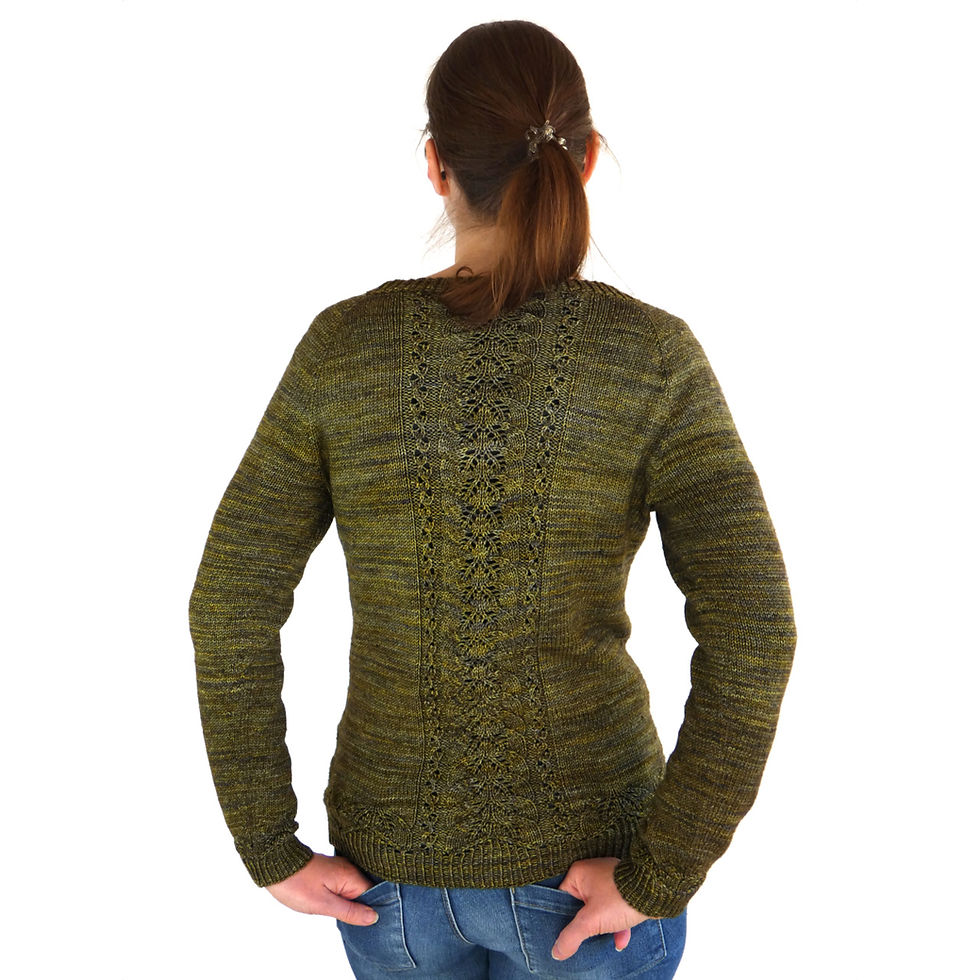
Wychwood Cardigan is a lighter-weight version of the original aran-weight Wychwood pullover, released in 2025. The two designs share some signature elements but the cardigan re-imagines them in a more warm-weather appropriate way.
The reasons for revisiting the design are two-fold. First off, I think the twin-leaf lace pattern is so pretty it deserves another appearance. But I didn't want to just re-grade the exact same design in a different yarn weight — that would be creatively stifling. Instead, I took the leaf-lace panel, moved it to the back of the garment, and re-built the rest of the design around it: it's now a cardigan, uses fingering-weight yarn, and has added leafy details around the hem and sleeve cuffs.

The second reason was practical and perhaps a little self-serving: I'd had a sweater quantity of the olive-green yarn in my stash for 10 years so it was high time to use it up. Pairing a muddy green yarn with a leafy lace pattern seemed… appropriate. But more on yarn choice later.
Like the original Wychwood pullover, the re-imagined Wychwood Cardigan is also a top-down compound raglan in construction. Whereas in traditional raglan shaping all four raglan lines increase evenly and at the same rates, compound raglan shaping arranges the increases in a way that more closely mirrors the shape of real bodies: they're are worked in an S-curve pattern instead of a constant rate of 8 stitches on every other row. Additionally, body and sleeve increase rates are detached from one another, creating more flexible and fine-tuned shaping in the upper body.
Unlike in Wychwood pullover, there's no asymmetry in the cardigan: back raglan lines are the same length as the ones on the front. There's enough going on in the pattern already — the scooped neck is shaped at the same time with the raglan increases — so I felt adding in asymmetry as well would have been a bit too much.

But there are a few difference between the designs as well. Moving the twin-leaf lace panel to the back of the garment is an obvious one. Having the lace hidden at the back meant the front of the garment would have looked quite pedestrian. Just an ordinary cardigan in plain stockinette — where's the fun in that?
To amp up the forest theme, the hem and sleeve cuffs are decorated with additional lace details. On the lower edge of the body, the double leaves are the same as on the back panel, only now going horizontally around the entire hem. On the sleeve cuffs, the leaf-lace pattern has been scaled down a smidgen. And just like in the original Wychwood, the leaves come to a pointy end and gradually transform into twisted ribbing.
I have to warn, though, that the lace pattern is a little complex: you need to do yarnovers and decreases on both the right and the wrong sides of the work. P2tog tbl and CDDp will have your and needles (and brain) in a pretzel… As always, instructions for all lace patterns are provided both as charts and in row-by-row written format.

The way the continuous button bands are worked is quite ingenious, even if I do say so myself. It's the same approach as on Lyrides and Draconides, only this time the button bands span the entire front edges of the garment. Stitches are picked up — only once! — in one fell swoop up the right front, around the scooped neck, and down the left front.
To achieve a smooth change in direction from vertical button bands to a horizontal neckband, mitered increases are worked at the top corners. Yarnover buttonholes disappear without a trace into the purl columns in the ribbing. Coming up in a couple of weeks I have another blog post about continuous button bands so stay tuned for the tutorial!

Another technique featured in the pattern is using a provisional cast-on at the underarms. With this approach there's no picking up stitches involved because the underarm stitches are already live. And because the stitches are live, there are also no bulky seams or joins. In my tutorial I've also shared by favorite tips for avoiding underarm holes by knitting into a middle of a stitch in the gap between held sleeves stitches and newly cast-on, provisional underarm stitches.

The biggest change from the original Wychwood pullover to this re-imagined cardigan version is the switch from aran- to fingering-weight yarn, from a winter pullover to a lightweight garment that's perfect for layering through spring, summer, and early autumn.
My olive-green sample cardi was knit from deep stash: in Malabrigo Yarn Sock (100% superwash wool, 402 m/100 g, 440 yd/3.53 oz) in the colorway 851 Turner. Despite the name, it isn't really a sock yarn but the fabulous color range and soft hand make it ideal for lightweight garments.

My test knitters used anything ranging from commercial, solid-colored yarn, such as DROPS Fabel and Knit Picks Palette, to fancier hand-dyed semi-solids like Skein Queen Crush and Symphonie Yarns Terra. A solid color makes yarn management easier but a hand-dyed yarn can add an extra depth and dimension to the design.

If you're using a hand-dyed tonal, like I did, it's a good idea to alternate skeins to prevent pooling, flashing, and abrupt color changes. I learned that the hard way when I started working on the sleeves.
The three skeins I had looked pretty identical on the skein with the usual color variation you get in tonal hand-dyed yarns. But, they weren't as evenly-matched as I'd anticipated. On one sleeve you could see the color change if you knew what to look for. One the other? It was blindingly obvious.

What I thought were three similar skeins were instead a sequence from light to mid to most saturated. By pure chance I'd cast on the cardigan with the lightest of the three, and was able to fade and blend in the switch by alternating skeins for 8 to 10 rows or so. In the end, the color effect looks like an intentional subtle gradient looks rather than unplanned and haphazard.
To knit the pattern you'll need fingering- or light fingering-weight yarn that gives you the gauge of 25 sts × 39 rows per 10 cm, approximately 1130–2480 m or 1230–2710 yd, depending on size. Size-by-size yardages are listed on the pattern page.

Apropos sizes, Wychwood Cardigan is available in 10 sizes from XS to 6X, graded based on upper bust circumference. The smooth stockinette body is ideal for adding shaping details without interrupting any of the design. To make room for larger than a B-cup bust, the pattern includes instructions for optional vertical bust darts along with customizable instructions that can be calculated based on your own body measurements. Waist shaping is also included.
Finished body circumferences range from 76 to 167 cm or from 30" to 66". Finished full bust circumferences — including the suggested bust darts — range from 81 to 182 cm or from 32" to 71½" inches but, as said, this is adjustable with custom bust darts.

Wychwood Cardigan is now available in my pattern shops on Payhip, LoveCrafts, and Ravelry (seizure warning). Color possibilities are endless with this one but I'm always partial to greens: from bright apple to rich emerald to murky olive… and everything in between! If you decide to cast on one, share your cardigan on Instagram using the hashtags #wychwoodcardigan and #talviknits.
Pin this post!


Comments