


Eliminating Jogs in Colorwork: An Easy Way and a Better Way

Updated: Mar 10
Colorwork jogs: what are they and why do they happen? In this blog post you'll find out what causes these annoying visual gaps when knitting colorwork in the round. You'll also learn two ways of fixing them, one that's easy to do and another that requires a bit of advance planning.
What's a Jog?
Knitting in the round is a bit of a misnomer. Technically, we're not knitting in the round; we're knitting in a spiral.

Think of circular knitting as a long coil spring. The beginnings and ends of round never meet at the same level: they're always offset from one another by the height of exactly one round. The last stitch of the first round is next to the first stitch of the second round.
If you're working in one-color stockinette, the spiral nature of in-the-round knitting is completely invisible and poses no problems. Because the beginnings and ends of the round look exactly the same, you can't see where the round changes from one to the next.
But things can get a little dicey with any stitch pattern that involves alternating knits and purls, stripes, or colorwork — basically anything other than plain stockinette. The visual discrepancy you get at the change of rounds is called the jog: "a brief abrupt change in direction" according to Merriam-Webster.
In stranded colorwork the jog can be very noticeable because it results in an interruption in the pattern, as if part of the motif has been distorted. Patterns often try to hide to jog by placing the beginning of round (BOR) in as inconspicuous a place as possible, such at in the back, back shoulder, or side seam. In colorwork yoke sweaters, though, the BOR is usually smack in the middle of the center back. While you can't see the jog, others will…
An Example with Sheep and Charts

Here's a sheep colorwork chart from Andrea Rangel's AlterKnit Stitch Dictionary, and it's a great example for demonstrating jogs in colorwork. If you lay two chart repeats side by side, the motif appears to be continuous. But looks can be deceiving...

The dreaded jog surfaces when knitting this pattern in the round and you get to the very last motif on the top row. There's something wonky going on with this sheep.

To reveal what's happening here, you need to take the spiral nature of in-the-round knitting into account. We can simulate the ends of rounds ending up one round higher by laying two chart repeats side by side so that the one on the right is shifted upward. Now you can see why the last sheep on the top row is distorted: its hindquarters are offset from the front!
Next, I'm going to demonstrate two methods for eliminating jogs in colorwork: an easy way and a better way. No more wonky sheep!
Easy Way: Lifted Increase Method
There are several jogless jog methods but this one is my favorite to use with colorwork because it easy, quick to do, and works relatively well... if used sparingly.
It comes from June Hemmons Hiatt's book The Principles of Knitting (second edition, page 33) in which she calls it the raised increase method. In today's knitting lingo raised increases are better known as lifted increases.

To use this method, work the first colorwork round of the motif normally (in this case rnd 9). At the beginning of the second round (rnd 10) lift the stitch below the first one onto the holding needle, then K2tog the lifted stitch and the first stitch.

This method needs to be done any time there's a color change that straddles the BOR. If there's no color change at BOR, just keep knitting with the same color you're already using. Work the chart on the right only once at the beginning of the round, then repeat the one on the left for the rest of the round.

Pulling up the first stitch of the round makes the motif appears (more) continuous... but it doesn't fix the jogs completely. The sheep's feet now seem to start more or less on the same level. The back looks more straight but there's still definitely some wonkiness going on in the belly.
The lifted increase and other jogless jog methods rely on the same principle: they fool the eye into thinking that the beginning and end of round meet at the same level. But there's a downside to the easiness. This method works best when used infrequently and not on too many consecutive rounds as it can cause lumps, bumps, distortions, or thicker areas in the fabric.
Better Way: Shifting the Chart
But what if there were a better way? What if the jog didn't exist at all?
The better method involves shifting parts of colorwork motif up or down as needed so that there is no jog. It takes advantage of the spiral nature of in-the-round knitting instead of fighting against it like the jogless jog methods. But it does require a bit of planning and forethought with charts.

Here again is our broken-up sheep with a droopy backside. First you need to identify the stitches that are causing the jog to become evident. In this case, you could move either the front of the sheep downward or the back half of the sheep upward. I'm picking the back half because it has fewer stitches so that's less of a change to the chart.

Next, re-draw the chart so that everything else stays the same but only the problematic stitches are moved so that they're aligned with the rest of the motif. The sheep becomes whole again.

To use these charts in knitting, reverse the order. Align the charts vertically so that they're back on the same level. Work the modified chart on the right only once, then repeat the one on the left for the rest of the round. Essentially you're delaying the start of the red-bottomed sheep and also completing it later than the rest.
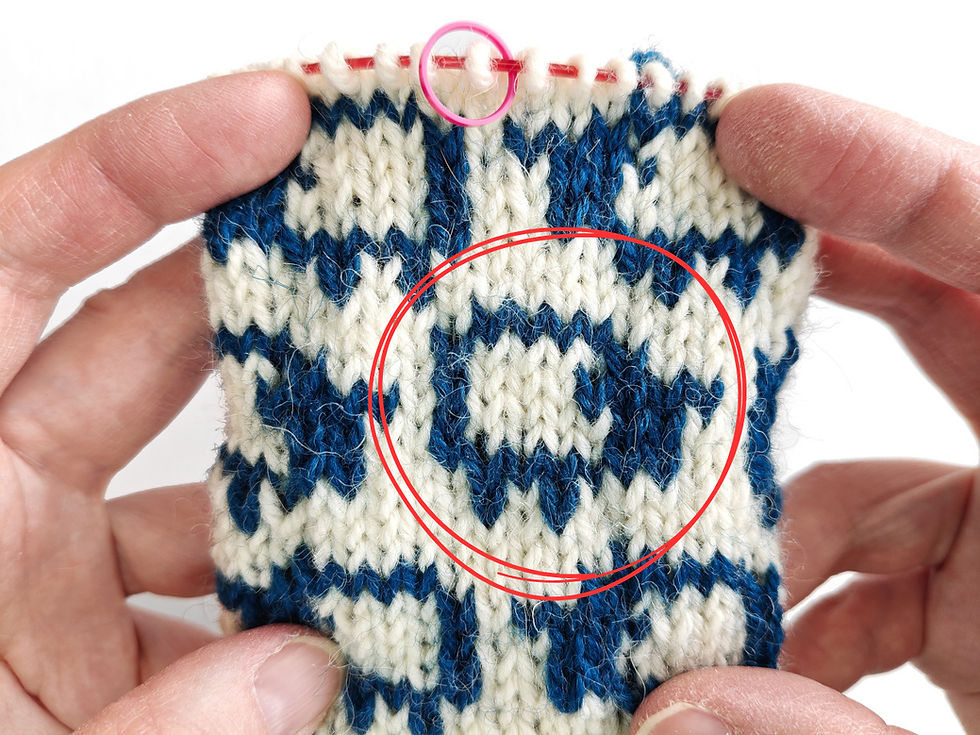
If the lifted increase method was about fooling the eye, there's a bit of a trompe l'oeil happening here, too. While the colorwork motif itself is now uninterrupted, it has moved in relation to the others surrounding it. But can you spot the difference? The human eye is drawn to the pattern, not what's between the patterns. Indeed, the shifting chart method works only with colorwork patterns that have whitespace or gaps so that there is somewhere for the motif to move to. If the chart is seamless and continuous, there's nowhere to hide and the jog will only follow you around no matter where you try to shift it.
Which Method to Use?
The choice between the lifted increase method and the shifting chart method depends on the motif in question. Can you get by with lifting a stitch here and another there? Use the lifted increase method. Does that pattern have gaps and whitespace? Use the shifting chart method. You can even mix and match them as needed based on which makes more sense in the situation.

In the upcoming Luode colorwork yoke sweater pattern, for instance, I used the lifted increase method for the one-row stripes separating the scrollwork pattern from the rest. Within the scrollwork motif, however, I shifted the colorwork pattern so that the diagonal line straddling the BOR remained continuous. The result is jogless, even if the BOR is in the middle of the back.
With colorwork jogs it's a bit of a compromise of where and how big of a visual interruption you can accept. And with enough experience you can develop an inner eye and let go of re-drawing the charts in advance — shifting the motif up or down becomes second nature.
Pin this post!



Comments