


Feather and Fan vs. Old Shale: What's the Difference?

Updated: Oct 14, 2025
One of my pet peeves in knitting (and life in general) is when people call things by the wrong name. Like thinking all stranded colorwork is Fair Isle when the former is a knitting technique and the latter is a distinct regional style of colorwork. Or attributing that surprisingly stretchy bind-off method to some "Jenny", not realizing that the real person behind the technique, Jeny Staiman, spells her first name with only one 'n'.
Or calling that pretty lace pattern Feather and Fan. Or if you're hedging your bets: Feather and Fan or Old Shale.
In this blog post you'll learn that Feather and Fan and Old Shale are actually two different lace stitch patterns. I'll demonstrate two ways you can identify which is which: visually or by stitch structure.
But first, a little history.
Why the Mix-up?
When and why did knitters start calling one particular lace pattern by two names? To explain the history behind this mix-up, I'll refer to my favorite post about the subject on Liz Lovick's Northern Lace blog. This post recently went offline but can still be reached via the Wayback Machine:
Sometimes one person’s slip can cause decades of error. This is definitely the case with the two separate and different Shetland patterns. Feather and Fan is NOT the same as Old Shale. It never was and never will be. Someone, somewhere, about WWII made the slip and it went to the States to be handed down from generation to generation.
The original cause of the mishap is long lost in history but, as a result, knitters have been mixing up these two lace patterns for decades. Even the great Barbara Walker uses this monstrosity of a double name next to the photo of Old Shale in her first treasury (page 205). While stitch patterns don't have standardized names, Walker is as close to gospel as it gets. I'm not saying BW is to blame but no doubt the popularity of her stitch dictionaries is what disseminated the mistake even further.
These days, 99% of the time when someone uses the phrase "Feather and Fan or Old Shale", they actually mean just Old Shale. The real Feather and Fan is nearly forgotten but lives on in the name.
Light as a Feather
Let's look at the real Feather and Fan lace pattern first. And it probably looks nothing like you thought it did! But the clue is in the name: Feather and Fan resembles a bird's feather.

The stitch pattern is made up of a central knit stitch surrounded by a series of yarnovers that make the knitted fabric fan out in both directions. That central stitch is like the shaft of a feather with individual barbs extending outwards from it.

When multiple repeats are worked side by side, each individual "feather" is distinct. The resulting effect is jagged and angular, and made up of vertical columns of lace repeats.
She Sells Sea Shells
Old Shale is the stitch pattern you've probably been referring to Feather and Fan for your whole knitting career. Whereas Feather and Fan produces very sharp edges, Old Shale is smooth and wavy.

Sometimes Old Shale is worked with an all-knits wrong-side row which creates a purl ridge on the right side of the work. This accentuates the wavy, rolling effect. The lace pattern resembles the look of scallop shells and that's where the name comes from. Here's Liz Lovick again:
[Old Shale] is really called old SHELL – shale is how the Shetlanders pronounce shell – the dialect form is probably shael
Another explanation for the name comes from Barbara Walker who notes that
It is believed that the name "Old Shale" came from a resemblance to the undulating print of waves upon shale sands.
Either way, Old Shale has a thematic connection to waves, seas, and shores.

Old Shale is also made up of series of yarnovers that fan out on both sides of the center stitch but that's pretty much where the similarities end. When multiple repeats are worked side by side, it's not immediately obvious where one repeat ends and another begins. Instead, the repeats blend together smoothly and create a wavy effect, much softer in look than the angular edges of Feather and Fan.

To sum up, here are quick tips for telling the two lace patterns apart just by looking at them:
Feather and Fan
looks like a feather
distinct vertical repeats
sharp angles
Old Shale
looks like a scallop shell
repeats blend together
smooth and wavy
can have a purl ridge (but not always)
Stitch Structure
If you want to go beyond mere looks, there's another easy way to tell the two stitch patterns apart: does it have single or multiple decreases?
Both Feather and Fan and Old Shale are similar in the sense that they have an equal amount of increases (yarnovers) and decreases so that the stitch count remains constant on all rows. But how those decreases are arranged is what sets them apart.
Both stitch patterns can also have infinite variations. In this post I'm demonstrating the patterns with a case in which both have three yarnovers on both sides of the center stitch (indicated with an arrow), six in total. I'm also using mirrored decreases whereas traditional Shetland lace patterns are often worked with only right-leaning ones.

In Feather and Fan, you have multiple pairs of (yo, K1), yarnovers separated by a knit stitch. To counter-balance the increases you have only one multiple decrease at each end of the repeat.
Row 1 (RS): K4tog, (yo, K1) five times, yo, SSSSK.
Row 2 (WS): Purl.
The more (or fewer) yarnovers in the variation, the bigger (or smaller) the decrease you'll need: triple decreases (K3tog and SSSK) for two yarnovers, quadruple for three like in the example above, quintuple for four, and so forth. The decreases stacked on top of each other on every other row — especially if they're of the -ple variety — is what makes that sharp, angular edge. The more yarnovers, the bigger the decrease, and the sharper the angle.

Old Shale is structured very much the same way: decreases on each end of the repeat and, in the middle, yarnovers separated by a knit stitch arranged symmetrically on both sides of the center stitch. But what's different compared to Feather and Fan is that the increases are balanced with multiple single decreases (K2tog and SSK) worked back to back.
Row 1 (RS): K2tog three times, (yo, K1) five times, yo, SSK three times.
Row 2 (WS): Purl.
Row 3 (RS): Knit.
Row 4 (WS): Purl. (Or, if you want the purl-bump version: Knit.)
The more yarnovers in the variation, the more single decreases on each end of the repeat, equal to the number of yarnovers on each side of the center stitch. The decreases are still stacked on top of each other but now spread out over multiple stitches and on every fourth row. This is what makes the smooth, wavy effect as opposed to the jagged edges of Feather and Fan.
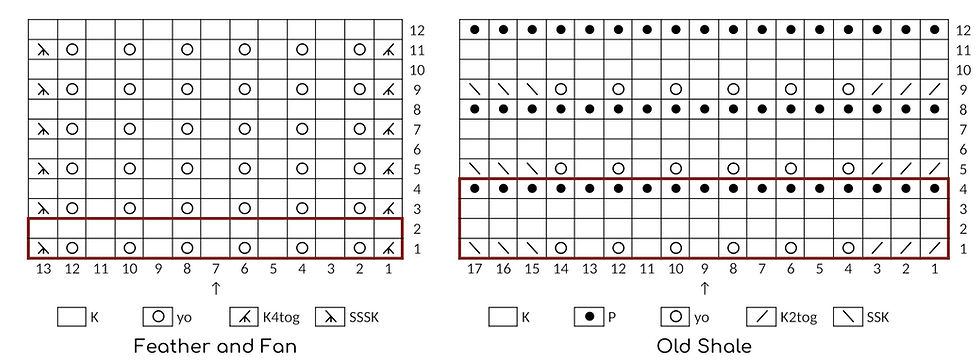
Comparing the charts for the lace patterns side by side you can see that they're actually very similar. In that sense it's quite understandable that the mix-up happened somewhere along the line, and we started fusing the two together.
But it's that subtle change in the decrease arrangement that drastically changes the look. Multiple single decreases back to back? It's Old Shale. One triple/quadruple/quintuple decrease on each end? It's Feather and Fan.
Next time you hear someone referring to a stitch pattern as "Feather and Fan or Old Shale", you'll know better. Be the other 1%.
Pin this post!


![7 Ways to Knit a Left-leaning Decrease [Tutorial]](https://static.wixstatic.com/media/2a6e85_3668e923c97645eba6c4075b7ed4f9ec~mv2.png/v1/fill/w_600,h_900,al_c,q_90,enc_avif,quality_auto/2a6e85_3668e923c97645eba6c4075b7ed4f9ec~mv2.png)


Another excellent article! Thank you... I just love the deep dives and knitting-geek (that is a high compliment) detail.